
How to Calculate EMI: Formula, Excel and Flat-Rate Loans
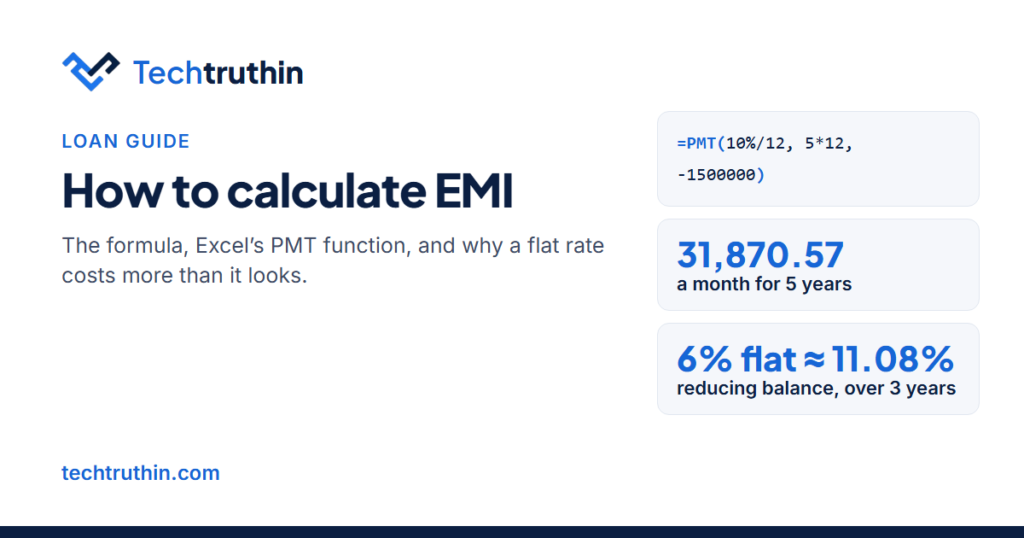
To calculate EMI, the fixed monthly payment on a loan, you need three numbers: the amount borrowed, the yearly interest rate and the number of months. Put them into one formula, or into the PMT function in Excel or Google Sheets, and you have the payment. There is a fourth thing to check: whether the lender charges interest on what you still owe or on the original amount. That choice can nearly double the interest you pay on a loan that shows the same rate, and this guide shows how to spot it. Outside South Asia, EMI is usually just called the monthly loan payment, and the formula is the same one Excel uses.
If you only want the answer, our Loan and EMI Calculator does every step below and draws the repayment schedule. The steps below show where that number comes from, so you can check a lender’s figures yourself.
The EMI formula
EMI stands for equated monthly instalment. “Equated” means every payment is the same size. For a loan where interest is charged on the balance still owed, which lenders call reducing balance or “monthly rest”, the payment is:
EMI = P × r × (1 + r)n ÷ ((1 + r)n − 1)
- P is the principal, the amount you borrow.
- r is the monthly interest rate as a fraction. Divide the yearly rate by 100, then by 12. A 10% yearly rate becomes 0.10 ÷ 12 = 0.0083333.
- n is the number of monthly payments. A 5-year loan has 60.
Why this shape? Each month the lender adds one month of interest to the balance, and your payment takes some of it away. The formula finds the one payment that brings the balance to exactly zero after n months. The (1 + r)n part is how much the balance would grow if you paid nothing at all.
A worked example, step by step
Say you borrow 1,500,000 at 10% a year for 5 years. The currency doesn’t matter: the maths is the same for rupees, naira, pesos or anything else. A phone calculator is enough.
- Monthly rate: 10 ÷ 100 ÷ 12 = 0.0083333… Keep the full value in your calculator rather than retyping the rounded figure.
- Number of payments: 5 × 12 = 60.
- Growth factor: (1 + 0.0083333)60 = 1.645309. Use the xy key, or type (1+0.1/12)^60 into a search box.
- Top line: 1,500,000 × 0.0083333 × 1.645309 = 20,566.36.
- Bottom line: 1.645309 − 1 = 0.645309.
- EMI: 20,566.36 ÷ 0.645309 = 31,870.57 a month.
Over 60 months you pay about 1,912,234 in total, so the interest is about 412,234. Keep as many decimal places as your calculator allows. Rounding 0.0083333 to 0.008 looks harmless, but it lowers the payment by almost 300.
Where each payment goes
The payment stays the same, but what it pays for changes every month. In the first month of the loan above, interest is 1,500,000 × 10% ÷ 12 = 12,500, so only 19,370.57 of your 31,870.57 reduces the balance. Next month the balance is smaller, so the interest is smaller and more of the payment goes to the loan itself.
| Year | Interest paid | Principal repaid |
|---|---|---|
| 1 | 139,045 | 243,402 |
| 2 | 113,557 | 268,890 |
| 3 | 85,401 | 297,046 |
| 4 | 54,296 | 328,150 |
| 5 | 19,935 | 362,512 |
Longer loans make the effect much stronger. On a 250,000 home loan at 7% over 20 years, the payment is 1,938.25 a month, and in the first year 17,311.59 of the 23,258.97 you pay is interest: about three quarters. Stretch the same loan to 30 years and the payment drops to 1,663.26, but the total interest grows from 215,179.36 to 348,772.25. A lower EMI is not a cheaper loan.
This is also why paying early saves so much. Every extra amount comes off the balance, so it stops collecting interest for the rest of the term. On that 20-year loan, paying 200 extra each month ends it after 197 months instead of 240 and saves 43,963.87 in interest. Ask your lender first whether it charges a fee for early or partial repayment.
How to calculate EMI in Excel or Google Sheets (PMT formula)
Both have a PMT function that uses the same formula. Microsoft’s PMT help page gives the syntax as PMT(rate, nper, pv, [fv], [type]), and Google’s uses the same order. For the example above:
=PMT(10%/12, 5*12, -1500000)
- Use monthly units for both rate and periods. Both help pages warn that the rate and the number of periods must match. Microsoft’s own example uses 12%/12 and 4*12 for monthly payments on a four-year loan. Putting the yearly rate into a monthly formula is an easy mistake to make, and it makes the payment far too high.
- Mind the sign. With a positive loan amount, PMT returns the payment as a negative number, because it is money going out; Microsoft’s examples show it in brackets. Put a minus sign in front of the amount, as above, to get a positive result.
- Leave the last two arguments out. fv is the balance left at the end (0 for a normal loan), and type 0 means payments at the end of each month, which is the default. Type 1 is for payments at the start of each period.
Microsoft notes that PMT covers principal and interest only, with no taxes, reserve payments or fees. Keep that in mind when you compare your sheet with a lender’s quote.
Flat rate loans: the EMI formula changes
Some lenders don’t charge interest on the balance. With a flat rate, interest is worked out on the original loan amount for the whole term, even after you have repaid most of it. MoneySense, Singapore’s official money guide, says flat rates are common for car loans and personal term loans, while home loans usually use monthly rest.
The flat-rate EMI is simple arithmetic:
Flat EMI = (P + P × flat rate × years) ÷ months
MoneySense’s example is a 90,000 car loan at 2.5% flat for 5 years. Interest is 90,000 × 0.025 × 5 = 11,250, so the payment is 101,250 ÷ 60 = 1,687.50 a month.
Same rate, very different cost
Here is a 10,000 loan over 3 years at 6%, charged both ways:
| Interest method | Monthly payment | Total interest |
|---|---|---|
| Reducing balance | 304.22 | 951.90 |
| Flat rate | 327.78 | 1,800.00 |
The flat loan costs almost twice as much interest. To see why, think about the final months: you owe only a few hundred, yet the flat loan still charges interest as if you owed the full 10,000.
To compare the two fairly, turn the flat rate into the reducing-balance rate with the same payment. A 6% flat rate over 3 years works out at about 11.08% reducing balance, and MoneySense’s 2.5% flat car loan at about 4.73%. Spreadsheets have no one-step function for this, but our calculator works it out when you choose “flat rate”. MoneySense’s advice is to ask your bank for both the advertised and the effective interest rate (EIR), and to use the EIR to compare loans. Formal EIR figures may compound the monthly rate into a yearly one, so a lender’s EIR can sit a little above our equivalent rate.
Why your bank’s EMI might not match
- Fees and insurance. Processing fees, loan insurance or taxes may be added to the payment or to the amount borrowed. In the US, the Consumer Financial Protection Bureau explains that the APR is the interest rate plus the lender’s fees, and says to compare APR with APR, never APR with an interest rate.
- The rate type. If the lender quotes a flat rate, convert it (see above) before comparing it with anything else.
- Variable rates. If the rate changes, the lender usually recalculates the payment, the term, or both. Any EMI you work out holds only while the rate stays the same.
- Rounding and timing. Lenders round each payment and may adjust the last one; some count interest by days rather than months. Small differences of a few cents or units are normal.
If a lender’s payment is far from yours, ask for the repayment schedule. MoneySense suggests asking for one in any case; it shows how much of each payment is interest.
How we checked the numbers
Every calculated figure on this page was checked with our loan calculator, whose automated tests (run on 25 November 2026) check it against Microsoft’s published PMT example, 10,000 at 8% over 10 months giving 1,037.03, and against MoneySense’s two flat-rate car loan examples (5 and 7 years). The step-by-step example was also worked through by hand with the formula above; rounding in the middle steps can move the last digit by a few cents.
Questions about calculating EMI
What is the formula to calculate EMI?
For a reducing-balance loan, EMI = P × r × (1 + r)^n ÷ ((1 + r)^n − 1). P is the amount borrowed, r is the yearly rate divided by 100 and by 12, and n is the number of monthly payments. For a flat-rate loan, EMI = (P + P × flat rate × years) ÷ months.
How do I calculate EMI in Excel?
Use =PMT(yearly rate/12, years*12, -loan amount), for example =PMT(10%/12, 5*12, -1500000), which returns 31,870.57. The minus sign before the amount makes the answer positive. Google Sheets uses the same function and order.
Is a flat interest rate the same as a reducing rate?
No. A flat rate charges interest on the original amount for the whole term, so it costs much more than the same reducing-balance rate. A 6% flat rate over 3 years costs about the same as 11.08% on a reducing balance. Compare loans using the effective rate.
Does a longer term make a loan cheaper?
It lowers the monthly payment but raises the total interest. A 250,000 loan at 7% costs 215,179.36 in interest over 20 years and 348,772.25 over 30 years, even though the EMI falls from 1,938.25 to 1,663.26.
Why is so much of my early EMI interest?
Interest is charged on the balance you still owe, and the balance is highest at the start. On a 250,000 loan at 7% over 20 years, 17,311.59 of the first year’s 23,258.97 in payments is interest. As you repay, the interest part falls and more of the same payment goes to the loan itself. Extra payments speed this up because they go straight off the balance.
Borrowing or repaying in a different currency from your income? The Currency Converter shows what each payment is worth in your own currency, and the Loan and EMI Calculator works out any of the examples above with your own numbers.
Sources
- Microsoft Support: PMT function (syntax, monthly units, worked examples, principal and interest only)
- Google Docs Editors Help: PMT (syntax, consistent units, end or beginning of period)
- MoneySense: Costs of borrowing: flat rate, monthly rest, and Effective Interest Rate (definitions, car loan example, comparing loans)
- Consumer Financial Protection Bureau: interest rate vs APR
This guide explains how loan payments are calculated. It is general information, not financial advice, and it doesn’t recommend any lender or loan. Excel is a trademark of Microsoft and Google Sheets of Google; Techtruthin is not affiliated with either. Sources checked on 25 November 2026.
How this guide was made: researched and drafted with AI assistance, then checked against the official sources linked above before publishing. Editorial policy Report a mistake