
YouTube’s November 2026 ad guideline update: critiquing ideas can now earn
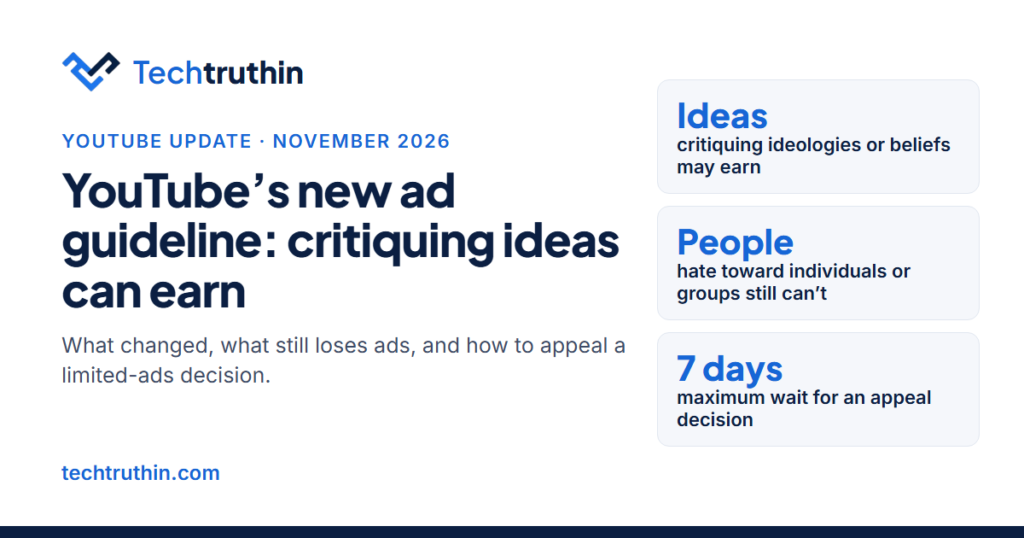
In November 2026 YouTube added a short entry to its log of ad guideline changes, and it matters to anyone who makes commentary, debate, religion, philosophy or politics videos. Content that critiques ideologies or beliefs may now earn ad revenue. Attacks on people and protected groups still can’t. This guide explains what the update says, what it doesn’t say, how it fits with the October and September changes, and what to do when a video still gets limited ads.
Facts checked against YouTube Help on 29 November 2026.
The short answer
- What changed: YouTube updated its Hateful and Derogatory content guidelines so that videos critiquing ideologies or beliefs “may be eligible to earn revenue”.
- What didn’t: hate or harassment aimed at individuals or protected groups stays ineligible for ad revenue.
- What YouTube left open: the update gives no examples and doesn’t say whether such videos get full or limited ads. When we checked on 29 November 2026, the detailed Hateful and Derogatory section didn’t yet include examples for the new wording.
- If a video still gets limited ads: you can ask for a human review from YouTube Studio. YouTube says an appeal can take up to 7 days and the reviewer’s decision is final.
What the November 2026 update says
YouTube keeps a running list of changes on its Upcoming and recent ad guideline updates page. The November 2026 entry is short. It says the Hateful and Derogatory guidelines now reflect that content critiquing ideologies or beliefs may earn money, and that hate or harassment towards individuals or protected groups remains ineligible.
The distinction is between ideas and people. An ideology or a belief system is a set of ideas. A protected group is a set of people, defined in the advertiser-friendly content guidelines by traits such as race, ethnicity, nationality, religion, disability, age, veteran status, sexual orientation and gender identity. A video can argue that an economic theory is wrong, or that a religious teaching doesn’t hold up, without attacking the people who hold it. That is the kind of video the update is about.
Why the main guidelines page still matters
Until YouTube adds examples for the new wording, the current text of the Hateful and Derogatory section is the best guide to where the line sits. Two of its examples are worth knowing:
- Can earn full ad revenue: criticising a person’s or group’s opinions, views or actions without incendiary or demeaning intent.
- Earns no ad revenue: portraying ideologies or beliefs in a malicious way by generalising or disparaging. The page’s example is a one-line insult that brands a whole movement as sick.
Read together with the November entry, the message is consistent. Making an argument against an idea is fine. Calling everyone who believes it sick, stupid or dangerous is not. Based on the current wording, a history channel explaining why a political movement failed, or a philosophy channel debating a religious claim, should fall on the eligible side. A video built around mocking believers as a group should not. YouTube hasn’t published its own examples yet, so treat these as a reading of the rules, not a ruling.
Comedy gets no automatic pass either. The guidelines say satire may be exempt, but that stating your comedic intent is not enough on its own.
The changes just before it
The November entry follows several other recent changes. The same page lists these:
| Month | Guideline | What can now earn |
|---|---|---|
| November 2026 | Hateful and derogatory | Content critiquing ideologies or beliefs (may be eligible) |
| October 2026 | Hateful and derogatory; harmful acts and unreliable content | Certain public-interest content, for example congressional proceedings and debates over ongoing government actions |
| September 2026 | Recreational drugs | Gaming and scripted content showing drug use or sale; public service announcements and non-glorifying educational content about drug trafficking organisations |
| September 2026 | Violent content | Graphic gaming content that appears in the first eight to fifteen seconds; graphic gaming content in the first seven seconds stays ineligible |
Our reading: taken together, these updates suggest YouTube is weighing the purpose and context of a video more than its topic alone. A news-commentary creator covering a heated debate in their country’s parliament, or a gaming channel whose video opens on a violent scene, has more room than before these updates. YouTube hasn’t described the changes as a trend, so judge each video against the written rules.
What “limited” and “no” ad earnings mean
The rules cover titles, thumbnails and tags too
These rules decide the ad status of each upload, and they cover more than the video itself. The guidelines say they apply to the video, Short or live stream, and also to its thumbnail, title, description and tags. A careful video can still lose ads because of a provocative thumbnail.
The two statuses
YouTube’s page Limited or no ad earnings explained defines the two outcomes:
- Limited ad earnings: the video can show ads, but brands that chose to run only on safer content won’t appear on it, so you should expect lower ad revenue.
- No ad earnings: the video can’t run ads. YouTube notes it may still suit other ways of earning.
You see the status in YouTube Studio. On the Content tab, the Notices column shows any limitation; hover over it for an impact summary with a button to act on it, as described in YouTube’s guide to the Content tab and notices. While checks are still running, YouTube recommends waiting before making the video public, because fixing a problem before release is easier than appealing after.
One more risk sits above single videos. The guidelines say YouTube may disable ads on an entire channel when most of its content is unsuitable for advertisers or there are repeated, serious violations. That is why it is worth getting the line right on every upload, not just appealing the ones that get flagged.
How to appeal a limited-ads decision
If you think a decision is wrong, you can ask for a person to look at it. The November update may give some commentary creators a stronger case, but YouTube hasn’t said how reviewers will apply it. YouTube’s appeal help page sets out the steps:
- Open YouTube Studio and go to Content.
- Find the video and open its notice in the Notices column.
- Choose Action and request a human review.
Some rules from that page are easy to miss:
- You get one appeal per decision, and the reviewer’s answer is final.
- An appeal can take up to 7 days.
- Deleting the video and uploading it again won’t help.
- Changing the title, description or thumbnail after publishing can bring new restrictions if the changes make the video less suitable for ads.
Appeal only when you are confident the whole video, metadata included, meets the guidelines. If the main argument is fair but a few lines in the middle generalise about a group of people, the reviewer may well keep the limit, and you will have used your one appeal.
Rate your own videos honestly
Channels in the YouTube Partner Program can rate their own videos through self-certification. After you turn on monetisation for an upload, you answer an ad suitability questionnaire about what the video contains, or choose “None of the above”. YouTube says access usually arrives a month or two after you join the programme.
Honesty pays here. YouTube compares your ratings with its own, usually after about 20 videos. If your ratings are accurate, YouTube says it will rely on your input over its automated systems. If they are repeatedly and badly inaccurate, your channel’s place in the Partner Program may be reviewed. For commentary channels, that means flagging a video that really does include strong language or heated material, rather than hoping the new rule covers it.
A checklist before you publish
- Target the idea, not the people. Rewrite lines that turn “this belief is wrong” into “these people are bad”.
- Check the packaging. The title, thumbnail, description and tags are judged too. Keep titles accurate rather than insulting; our character counter shows how long a title is before you paste it, and the YouTube tag counter checks your tags against the 500-character limit explained in our YouTube tags guide.
- Wait for checks. Leave the upload private or unlisted until the checks finish.
- Self-certify accurately. An honest rating builds the trust that lets YouTube rely on you.
- Know if you can earn at all. These rules only matter once a channel is in the Partner Program. Our YouTube monetization checker shows how close you are, and our guide to the 2027 monetization requirements explains the thresholds.
Frequently asked questions
Can videos criticising a religion earn money on YouTube now?
Videos that critique a religion’s beliefs or teachings may be eligible, according to YouTube’s November 2026 update. Religion is also a protected characteristic, so content that attacks, demeans or generalises about the people who follow a religion remains ineligible.
Will these videos get full ads or limited ads?
YouTube hasn’t said. The update only says such content “may be eligible to earn revenue”. The current guidelines give full ad revenue to criticism of opinions, views or actions without incendiary or demeaning intent, so tone is likely to decide the outcome.
Does the update apply to Shorts and live streams?
Yes. The advertiser-friendly guidelines say they apply to videos, Shorts and live streams, along with each upload’s thumbnail, title, description and tags.
Should I appeal old videos that got limited ads?
If an older video was limited only because it argued against an ideology or belief, and it doesn’t attack people or groups, the update may give you a better case. YouTube hasn’t said it will re-check old videos by itself, and if you already appealed that decision, the result was final. Otherwise, check the whole video and its metadata before you use your one appeal.
Can a video with no ad earnings still make money?
YouTube’s help page says a video with no ad earnings may still suit other revenue streams. Its notices guide lists ways to earn such as ads, YouTube Premium, YouTube Shopping and Supers. YouTube doesn’t say which of these stay available for a particular video, so check the impact summary on the video’s notice.
Sources
- YouTube Help: Upcoming and recent ad guideline updates (the November, October and September 2026 changes)
- YouTube Help: Advertiser-friendly content guidelines (hateful and derogatory examples, protected groups, satire, what the rules cover, channel-wide ad removal)
- YouTube Help: Limited or no ad earnings explained (what each status means)
- YouTube Help: Understand your Content tab and manage notices (where notices appear, waiting for checks, ways to earn)
- YouTube Help: Submit an appeal for limited or no ad earnings (appeal steps, 7-day timing, one appeal, re-uploads, metadata changes)
- YouTube Help: Self-certification overview (questionnaire, accuracy, consequences of inaccurate ratings)
How this guide was made: researched and drafted with AI assistance, then checked against the official sources linked above before publishing. Editorial policy Report a mistake