

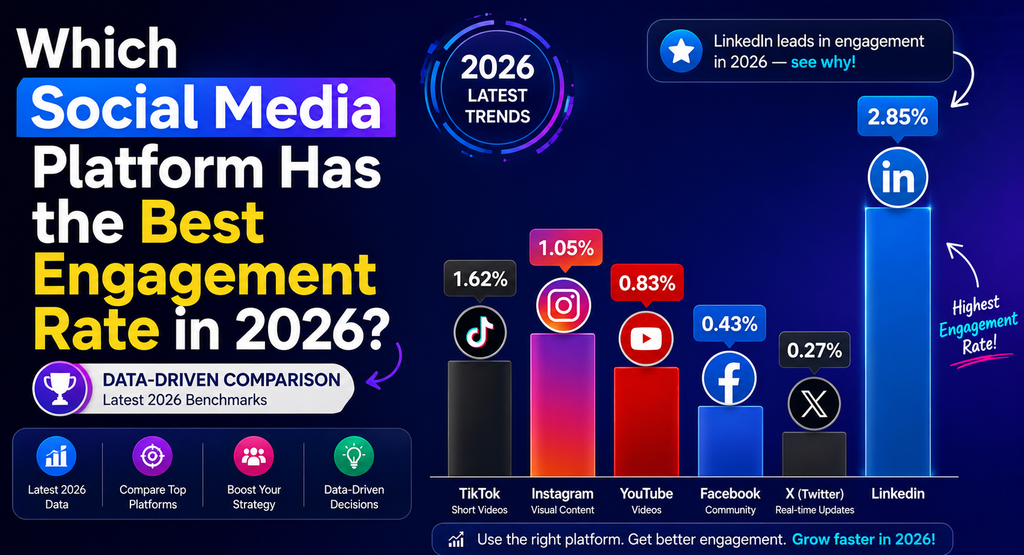
The best social media engagement rate in 2026 still belongs to LinkedIn — but the gap between platforms has shifted in ways most published rankings haven’t caught up to yet. Instagram’s rate actually declined instead of climbing. X posted the biggest relative jump of any platform. And Threads, once the breakout story of 2024, has settled into a much quieter phase. This Techtruthin.com breakdown covers the current best social media engagement rate by platform, based on Buffer’s newest study of over 52 million posts, and what the shift actually means for your content strategy.
Anyone chasing the best social media engagement rate for their brand or content needs data that’s actually current — engagement patterns move fast, and numbers from even a year ago can be misleading if treated as gospel today. If your own analytics have felt flatter than they used to, you’re not imagining it: engagement genuinely declined on several major platforms throughout 2025.
Key Takeaways
- LinkedIn still holds the best social media engagement rate overall, at a median around 6.2%, but its lead over Facebook has narrowed noticeably.
- Instagram’s engagement rate actually fell roughly 26% year-over-year — from about 7.3% to 5.4% — dropping it to third place.
- X posted the largest relative gain of any platform (~44%), though it’s climbing from a historically low base.
- Threads declined about 18%, drifting closer to X’s historically low range.
- Pinterest and Facebook both posted modest gains; TikTok held roughly steady.
What Is Engagement Rate, and Why Does It Matter?
Engagement rate measures how much people interact with content relative to how many people see it — it’s not about visibility alone, it’s about connection. A post reaching 10,000 people with only a handful of likes shows weak engagement; a post reaching 1,000 people that sparks hundreds of interactions shows the opposite, even with far less reach.
Understanding the best social media engagement rate on any given platform matters because it reveals three things reach alone can’t: how well content genuinely connects with an audience, how likely an algorithm is to amplify it further, and whether that audience is actively participating or just passively scrolling.
Important Context Before the Rankings
A few nuances matter for reading engagement data honestly:
- Engagement rate isn’t total volume. A platform with massive reach, like Instagram, can post a lower engagement rate while still driving more total interactions than a smaller, higher-rate platform.
- Each platform rewards different behaviors. LinkedIn leans on comments and discussion; Instagram leans on saves and shares. The best social media engagement rate on one platform doesn’t reflect the same underlying behavior on another.
- What counts as “engagement” varies by platform — saves, pins, comments, and replies are all weighted differently.
- Not all engagement is visible. DMs, bookmarks, and link clicks generally aren’t reflected in public engagement rate calculations.
Formula: engagement rate = (total interactions ÷ total impressions) × 100.
2026 Rankings: Best Social Media Engagement Rate by Platform
Based on Buffer’s analysis of 52+ million posts across 200,000+ accounts, here’s the current best social media engagement rate ranking by platform:
| Platform | Median Engagement Rate (2025) | Year-over-Year Trend |
|---|---|---|
| ~6.2% | Declined slightly (~5%) | |
| ~5.6% | Modest gain | |
| ~5.4% | Declined sharply (~26%) | |
| TikTok | ~4.6% | Roughly flat (~3% gain) |
| ~3.9–4.0% | Gained (~23%) | |
| Threads | ~3.6% | Declined (~18%) |
| X | ~2.8% | Largest relative gain (~44%, from a low base) |
According to Hootsuite’s Social Trends 2026 report, this shift reflects a broader industry pattern: audience attention is more fragmented across platforms than ever, and the best social media engagement rate by platform is increasingly a moving target rather than a fixed hierarchy.
LinkedIn is still on top, but the margin over Facebook has closed considerably compared to a year earlier. Instagram’s drop is the real surprise — a fall from top-tier to third place, tied closely to its continued push toward Reels at the expense of feed engagement. X’s jump needs context — a 44% relative gain still leaves it at the bottom of the best social media engagement rate table, since it’s rising from an unusually low starting point.
What’s Actually Driving These Shifts
LinkedIn’s position at the top of the best social media engagement rate rankings is holding, but growing platform popularity combined with a mid-2025 algorithm update appears to be diluting visibility for individual posts even as overall activity rises.
Instagram’s decline ties directly to its ongoing emphasis on Reels and short-form video. As attention shifts toward video, engagement on traditional feed posts is dropping — this looks less like the platform losing relevance and more like engagement relocating to formats not always captured cleanly in public metrics.
Threads’ decline reflects the natural cooling of any new platform’s early-adopter surge as its user base and content volume grow.
X’s relative gain deserves a cautious read. Algorithm and monetization changes over the past year have reshaped content distribution, and a low starting baseline makes percentage gains look more dramatic in isolation than they are in absolute terms.
Pinterest and Facebook both posted steady, modest gains — Pinterest through its search-driven, evergreen content model, and Facebook through continued strength in niche Groups and its older, highly engaged core demographic. Broader industry data from DataReportal’s Digital 2026 Global Overview Report confirms this pattern of platform fragmentation rather than one clear winner absorbing engagement across the board.
TikTok held roughly steady, suggesting the platform has entered a more mature growth phase after its earlier period of explosive engagement gains.
What This Means for Your Content Strategy
Chasing the single platform with the best social media engagement rate on paper isn’t a strategy on its own — the real question is which platform’s strengths align with your specific goals.
For high engagement per post: LinkedIn and Facebook remain strongest, with comment-driven, community content still performing well on both.
For reach at scale: Instagram still delivers volume despite a lower rate, and TikTok’s discovery algorithm continues giving smaller accounts real visibility.
For video-specific engagement: TikTok and Instagram Reels remain the top performers, particularly for building initial reach before nurturing deeper engagement elsewhere.
For real-time conversation: Threads and X still lead here, even with lower overall rates — both are built around immediacy in a way LinkedIn and Instagram simply aren’t.
The takeaway: match platform choice to your actual goals rather than defaulting to whichever platform currently posts the best social media engagement rate on a leaderboard.
Conclusion
The best social media engagement rate in 2026 still belongs to LinkedIn, but the underlying story is more interesting than one ranking suggests — Instagram’s genuine decline, X’s low-base rebound, and Threads’ cooling growth all point to a landscape shifting faster than most published comparisons account for. Rather than chasing whichever platform currently tops the list, match platform strengths to your specific content goals and adjust format and posting frequency accordingly. For more social media data breakdowns, visit Techtruthin.com.
FAQ: Best Social Media Engagement Rate
Which platform has the best social media engagement rate in 2026?
LinkedIn currently leads with a median engagement rate around 6.2%, followed by Facebook (~5.6%) and Instagram (~5.4%), based on analysis of over 52 million posts.
Why did Instagram’s engagement rate decline?
Instagram’s rate fell roughly 26% year-over-year, largely tied to its continued push toward Reels and short-form video, which appears to be pulling engagement away from traditional feed posts.
Is X’s engagement rate actually improving?
Relatively, yes. X posted the largest percentage gain of any platform (around 44%), though it’s climbing from a historically low base and still sits at the bottom of the rankings.
Does a higher engagement rate always mean more total interactions?
No. Platforms with massive reach, like Instagram, can generate more total interactions even at a lower engagement rate than a smaller, higher-rate platform like LinkedIn.
How is the best social media engagement rate calculated?
Engagement rate is calculated as total interactions divided by total impressions, multiplied by 100. What counts as an “interaction” varies by platform — likes, comments, shares, saves, and replies aren’t weighted the same way everywhere.
Which platform is best for real-time engagement specifically?
Threads and X remain strongest for immediate, real-time interaction, even though both currently post lower engagement rates than LinkedIn or Facebook overall.

Abdul Rehman writes for Techtruthin, covering tech, tools, and everything freelancing — from picking the right platform to actually getting paid on time. He tests most of what he writes about before publishing it, because secondhand opinions rarely hold up once you’re the one using the tool. Outside of writing, he’s usually chasing down whatever new app or gadget just dropped, mostly out of curiosity.